
FixWebsiteIssues.com, the technical SEO and healthcare marketing division of WevTEC, helps physicians, specialists, clinics, dental practices, urgent care centers, freestanding emergency rooms, and multi-location medical groups get found by the right patients. We combine medical SEO, Local SEO and Google Maps, technical website optimization, patient-intent content, Google Ads, and AI Search Optimization around the way patients actually search for symptoms, conditions, treatments, specialists, and nearby care. Houston-based since 2013, serving medical practices nationwide, with the goal of qualified patient inquiries rather than traffic for its own sake.
Houston-Based, Serving Practices Nationwide | Medical SEO + Technical SEO + Google Ads + AI Search | Working With Healthcare Practices Since 2013
Eight areas, each tied to a specific way patients find and choose a provider. Most engagements combine three or four of them; the audit tells us which.
Increase search relevance for specialties, services, procedures, conditions, and the patient-intent searches that lead to appointments.
Strengthen location signals, physician and practice relationships, and Google Business Profile health so the practice appears where patients search locally.
Service, condition, procedure, physician, location, and educational content planned from how patients describe their symptoms and needs.
Fix indexing, crawlability, site architecture, page speed, internal linking, and structured data so strong medical content is not hidden by a weak website.
Paid search built around high-intent service and specialty searches, with the landing pages, call tracking, and policy awareness medical campaigns require.
Improve calls, appointment requests, forms, mobile usability, and the path from a service page to a booked visit.
Structure content, entity information, and authority signals so the practice is more likely to be understood and referenced by Google AI, Gemini, ChatGPT, and Copilot.
Track qualified organic visibility, Google Business Profile actions, tracked calls, form submissions, and the outcomes that matter to the practice.
Healthcare SEO is the process of improving how easily patients can find a medical practice when they search for doctors, specialists, conditions, treatments, procedures, or healthcare services online. It combines technical SEO, medically responsible content, local visibility, physician and location optimization, reputation signals, and conversion strategy so that a relevant search connects with the right practice, and the visit turns into a call or an appointment request.
Medical SEO is not adding keywords to a doctor’s website. It requires understanding five things at once: what the patient means by the words they use, which specialty and service actually answer that need, whether the search is local, what makes a patient trust a provider they have never met, and whether the website can technically be found and used. A practice that gets four of those right and misses the fifth still loses the patient.
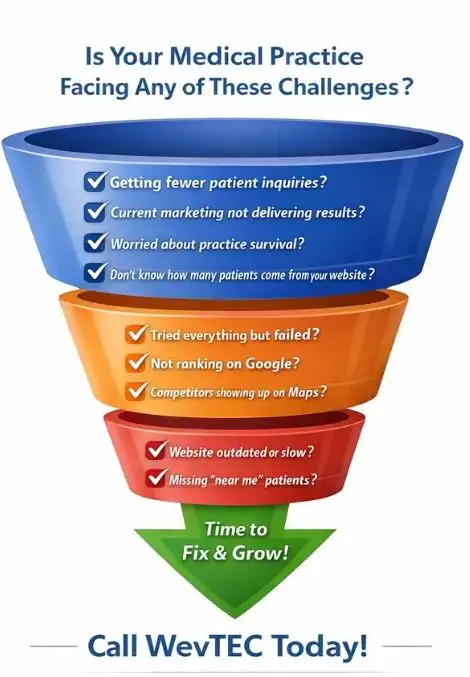
A cardiology practice with a single “Cardiology Services” page is competing for chest pain, palpitations, AFib, hypertension, heart failure, stress testing, and echocardiography with one URL. Patients search those individually. Each needs its own page, written in the patient’s words, linked to the physician who treats it and the office where it happens. That structure, not the keyword, is what healthcare SEO is.
Healthcare SEO is the organic-discovery discipline: earning visibility in Google Search, Google Maps, and AI-assisted search without paying per click. Medical marketing is the broader program that may also include Google Ads, landing pages, content strategy, reputation, website conversion, analytics, and patient acquisition planning. A practice may need only one; most growing practices need both, coordinated so paid and organic do not compete for the same searches.
FixWebsiteIssues delivers either on its own or as one combined program, depending on the practice’s stage, competition, and budget. The table shows where each discipline does its work.
| Area | Healthcare SEO | Medical marketing |
|---|---|---|
| Goal | Be found organically for specialty, condition, treatment, and local searches | Acquire qualified patients across every channel, paid and organic |
| Channels | Google Search, Google Maps, Bing, AI Overviews and assistants | SEO plus Google Ads, landing pages, reputation, website conversion, analytics |
| Time to effect | Months; compounds over time | Paid channels can produce inquiries in weeks while SEO builds |
| Core work | Technical SEO, architecture, content, local signals, physician and location pages, schema | Campaign strategy, budget allocation, landing pages, call tracking, conversion testing, reporting |
| Measured by | Non-brand organic visibility, Maps actions, organic calls and forms | Cost per qualified inquiry, blended patient acquisition, channel contribution |
| Best fit | Established practices building durable visibility for their specialties | New locations, new service lines, competitive procedures, or practices that need volume now |
Patients rarely start with “cardiologist near me.” They start with a symptom, move to a condition, compare treatments, look for the right kind of specialist, then narrow to someone nearby who is accepting patients and takes their insurance. Each stage uses different words and is best answered by a different kind of page. A practice that only targets the last stage is absent for most of the journey, which is where competitors and health portals earn the patient’s trust first.
| Patient search stage | Example searches | Best supporting asset |
|---|---|---|
| Symptom discovery | "why does my heart race randomly", "stomach pain after eating", "joint stiffness in the morning" | Educational content that explains possibilities and when to see a doctor, without diagnosing |
| Condition research | "AFib treatment options", "what is GERD", "rheumatoid arthritis vs osteoarthritis" | Condition page linked to the treatments and the specialist who provides them |
| Treatment or procedure research | "cardiac ablation recovery", "colonoscopy prep", "robotic hernia repair", "dental implant cost" | Treatment or procedure page with candidacy, what to expect, and next steps |
| Specialist search | "cardiologist for AFib", "gastroenterologist for acid reflux", "surgeon for gallbladder removal" | Specialty page and physician profiles with credentials and focus areas |
| Local intent | "cardiologist in Sugar Land", "urgent care open now", "dentist Katy TX" | Location page plus a complete, accurate Google Business Profile |
| Provider evaluation | "cardiologist accepting new patients", "does Dr. X take Blue Cross", reviews | Physician and location content with insurance, hours, and how to book |
| Conversational AI | "who should I see for recurring palpitations", "what kind of doctor treats leg swelling" | Clear, answer-first content with consistent entity information an AI system can retrieve and cite |
The same pattern holds in every specialty we work with. A primary care patient moves from “annual physical” to “same-day appointment” to “family doctor accepting new patients.” An urgent care patient collapses the journey into one stage: “open now, near me, do they take my insurance.” A dental patient may research veneers for weeks before searching for a cosmetic dentist. Strong healthcare SEO supports the whole journey, and it is honest about which stages a given practice can realistically win.
Fifteen disciplines that make up a complete program. Each is described by what it does for the practice, because a list of labels tells a physician nothing.
A written plan tying each specialty, service, and location to the searches it should win, in priority order, with the pages, content, and technical work required to get there. It is the document every other task refers back to.
Crawlability, indexing, speed, mobile usability, canonicalization, redirects, and structured data. Medical sites accumulate technical debt from EHR integrations, patient portals, and past agencies; we find and fix what is hiding your content from Google.
Location relevance for each office: consistent name, address, and phone across the web, location pages with real content, local citations, and the review signals that decide who appears in the map pack.
Categories, services, hours, photos, appointment links, Q&A, and posts kept accurate and complete, with practitioner listings managed so physicians and the practice reinforce rather than compete with each other.
Provider pages that carry credentials, board certifications, conditions treated, procedures performed, languages, locations, and insurance, structured so both a patient and a search engine can connect the doctor to the care.
Service pages rewritten to match the words patients use, with what the service is, who it is for, what to expect, which providers offer it, and where, plus a clear next step.
Educational content that answers what patients ask at the start of their search, guides them toward appropriate care without diagnosing, and links to the relevant condition, treatment, and specialist pages.
Procedure pages that address candidacy, preparation, recovery, risks in plain language, cost or insurance questions where appropriate, and how to schedule a consultation.
Distinct pages for every office with unique content, local landmarks and parking where useful, the providers who practice there, and services available at that site, avoiding the duplicate-page problem that plagues multi-location groups.
A deliberate link structure among symptoms, conditions, treatments, procedures, physicians, and locations so search engines understand the relationships and patients can move naturally through the journey.
Structured data for the practice, physicians, locations, services, and FAQs, implemented only where it reflects visible content, and entity consistency across the site, Google Business Profile, directories, and licensing boards.
Ongoing publication of patient-education, seasonal, and specialty content planned from search data, written in patient-friendly language, and reviewed by the practice for accuracy before publishing.
Clear phone and appointment CTAs, fast forms, insurance and hours visibility, mobile usability, and page-level testing so a ranking becomes an inquiry.
High-intent service and specialty campaigns with location targeting, negative keywords, policy-compliant ad copy, dedicated landing pages, and call and form conversion tracking.
Monthly reporting on non-brand organic visibility, Maps actions, tracked calls, forms, Ads conversions, and technical health, written for a practice administrator, not an SEO.
Local SEO matters in healthcare because most patients choose a provider they can reach, and Google Maps is where that choice is made for “near me”, “open now”, and city-plus-specialty searches. Maps visibility depends on the practice’s Google Business Profile, the consistency of its information across the web, the relevance of its website, its reviews, and proximity to the searcher. A practice can rank well in organic results and be invisible in the map pack, or the reverse.
A retail store has one listing. A medical group may have a practice listing per location plus a practitioner listing for each physician, and Google allows both. Left unmanaged, those listings compete with one another, carry conflicting hours and phone numbers, or point to the wrong location. A physician who leaves keeps a listing that still ranks. Duplicate listings created by staff or directories split reviews. Managing practitioner and practice listings as one system, with clear relationships and consistent data, is where most of our local SEO time goes for medical clients.
We do not promise map-pack positions. Proximity is a factor no agency controls. What we can do is remove every reason Google has to prefer a competitor: incomplete categories, inconsistent addresses, unanswered reviews, missing services, wrong hours, and location pages that say nothing.
Medical content strategy assigns a page type to each stage of the patient journey: educational articles for symptoms, condition pages for research, treatment and procedure pages for decisions, specialty and physician pages for choosing a provider, and location pages for finding one. Each type has a different job, a different reader, and a different set of searches, and they are linked so a patient can move from any one to the next.
A symptom article (“shortness of breath when lying down”) explains what the symptom can mean, when it warrants a visit, and when it warrants emergency care. It does not diagnose. A condition page (“heart failure”) explains the condition, how it is evaluated, and how the practice treats it. A treatment page (“medication management for heart failure”) and a procedure page (“echocardiogram”) address candidacy, expectations, and scheduling. A specialty page (“cardiology”) is the hub that links all of these together. A physician bio carries credentials, focus areas, and the conditions and procedures that doctor handles, and is often the page a patient reads last before calling. A location page answers where, when, and how to get there.
Patients search “heart flutter”, not “paroxysmal supraventricular tachycardia”. The page must use the patient’s words in headings and openings while staying clinically accurate in the body, and every condition, treatment, and procedure page we write is reviewed by the practice before it goes live. Copied or AI-generated medical content that nobody at the practice has read creates trust and quality problems that outweigh any ranking benefit.
Our guides on medical schema for doctors, E-E-A-T for medical websites, and content gaps on healthcare sites go deeper on this.
Instead of one “Cardiology Services” page, a practice that wants to be found across the patient journey needs pages for the searches patients actually make:
Every symptom page links to its likely conditions; every condition links to its treatments and the physicians who provide them; every physician links to their locations. That web of links is what tells Google, and an AI system, that this practice is the answer.
Medical websites are judged more strictly than most, by patients and by search quality systems, because the consequences of bad information are higher. Google’s quality guidelines single out health topics as ones where experience, expertise, authoritativeness, and trustworthiness matter most. That is not a ranking switch you flip; it is a set of practical signals a practice either has on its site or does not.
We treat the items on the right as requirements, not extras. Most are inexpensive. Most are missing on the medical sites we audit.
Technical SEO is the work that lets Google crawl, render, index, and trust a medical website. When it fails, excellent clinical content simply does not appear, and the practice usually has no idea why. This is the part of healthcare marketing where FixWebsiteIssues has its deepest history: the company began as a website repair service and still fixes broken, hacked, and de-indexed sites every week.
Medical websites have particular technical risks. Patient portals and scheduling widgets inject scripts that slow pages or hide content. Provider directories generate thousands of thin, near-duplicate URLs. Migrations between agencies leave redirect chains and orphaned pages. A staging site gets indexed. A well-meaning plugin adds a noindex to the entire blog. Each of these is invisible from the front end and fatal for search.
Technical work is done by our own engineers rather than handed off. Where a site needs deeper repair first, our SEO repair, hacked website repair, and website maintenance teams handle it, and for Houston-area practices our Houston website maintenance plans keep it fixed.
AI Search Optimization for healthcare is the work of making a practice’s information clear, consistent, crawlable, and corroborated enough that AI-assisted search systems can understand what the practice does, who its physicians are, where it is, and which patient questions it answers, so it is more likely to be retrieved and referenced when a patient asks. It does not guarantee a mention in ChatGPT, Gemini, or an AI Overview. No agency can. It improves the odds by removing the reasons a system would skip the practice.
Patients now ask complete questions instead of typing fragments: What type of doctor treats recurring palpitations? Should I see a gastroenterologist for stomach pain after eating? Who treats rheumatoid arthritis in Katy? What kind of surgeon repairs an inguinal hernia? Which specialist should I see for leg swelling? Google’s AI Overviews and AI Mode, Gemini, ChatGPT, Copilot, and Perplexity answer those by retrieving and synthesizing web pages. A practice whose site states plainly that Dr. Smith, a board-certified cardiologist at the Sugar Land office, evaluates palpitations and performs ablation, and whose directory listings agree, gives those systems something to work with. A site with a “Services” page and a contact form does not.
We deliver this through the same disciplines as our cross-industry AI Search Optimization practice, applied to medical entities: Generative Engine Optimization for citation-worthiness, Answer Engine Optimization for question-level content, LLM Optimization for entity accuracy, and Google AI Optimization aligned with Google’s own guidance. The starting point is always an AI Visibility Audit that records what these systems say about the practice today.
They share a foundation but reward different things. A practice that treats them as one channel usually wins none of them well.
Ranks web pages by relevance, quality, and authority for a query. Rewards clean technical SEO, pages that match patient intent, strong internal structure, and credible content. Measured in Search Console by query and page.
Ranks local entities, not pages. Depends on the Google Business Profile, proximity to the searcher, categories, reviews, and consistency of the practice’s information across the web. The website supports it; it does not replace it.
Compose an answer from Google’s index and link to supporting pages. Favor factual clarity, accessible content, clear entity understanding, and answer-oriented passages. Same fundamentals as Search, with a premium on being quotable.
Answers natural-language provider questions by combining what the model learned with live retrieval, often from Bing’s index. Depends on corroborated business information, contextual relevance, and content that answers the question directly.
Every specialty has its own patient vocabulary, journey length, and competitive set. These are the specialties we work in, with the search patterns that shape the strategy for each. Where a dedicated resource exists, the card links to it.
Chest pain, palpitations, AFib, hypertension, heart failure, vascular testing, and diagnostic searches, mapped to condition, procedure, and cardiologist pages.
Stomach pain, acid reflux, colonoscopy, endoscopy, IBS and digestive conditions, GI specialist searches, and self-pay procedure pricing where applicable.
Arthritis, autoimmune conditions, joint pain and stiffness, rheumatologist searches, and the long-term care content that builds trust over months.
Preventive care, chronic disease management, annual visits, same-day and new-patient searches, and the local PCP queries that decide where a family goes.
Immediate local intent: open now, wait times, common conditions, insurance, and location relevance, where Maps and hours accuracy matter more than long content.
High-intent emergency and symptom searches, 24/7 availability, freestanding ER differentiation, and location clarity, written so nothing delays emergency care.
General dentistry, emergency dental, implants, cosmetic services, and local dentist searches for single and multi-location practices.
Veneers, implants, clear aligners, and whitening: longer research journeys, cost questions, and consultation conversion.
Hernia, gallbladder, appendix, robotic and minimally invasive procedures, and the surgeon-selection searches that follow a referral.
Weight-loss procedures, candidacy and BMI questions, cost and insurance, seminars, and surgeon-related searches.
Joint pain, sports injuries, replacement and arthroscopic procedures, and orthopedic specialist intent by body part.
PAD, vein disease, circulation symptoms, leg swelling, diagnostic testing, and vascular specialist searches.
Skin conditions, medical dermatology, skin cancer screening, and the cosmetic services patients research separately.
Women’s health, preventive services, pregnancy-related searches, and gynecologic care with appropriate sensitivity.
Procedure-specific journeys, before-and-after expectations, consultations, and reputation across a national patient base.
Injectables, aesthetic treatments, local discovery, and booking conversion in a heavily competitive market.
The verticals below reflect the healthcare organizations FixWebsiteIssues and WevTEC currently support with SEO, technical website management, and marketing. Client names and results are shared only with permission; the descriptions cover the kinds of problems handled in each.
Freestanding ERs and urgent care centers in Houston and Texas: open-now and symptom intent, location pages, Google Business Profile accuracy, hours and insurance visibility, technical fixes on high-traffic sites, and Google Ads under healthcare policy constraints.
Cardiology and vein/vascular practices: symptom-to-condition-to-procedure architecture, physician pages, diagnostic service pages, local search across multiple offices, and AI-readiness of entity information.
GI practices and colonoscopy providers: procedure and prep content, self-pay and screening searches, provider pages, and technical cleanup on sites carrying patient portals and scheduling integrations.
Primary care and multi-specialty clinics: new-patient and same-day intent, service-line pages, location consistency, review strategy, and conversion paths on mobile.
General surgery and surgical weight-loss practices: procedure pages with candidacy and expectations, surgeon profiles, seminar and consultation conversion, and Google Ads for high-value procedures.
General and cosmetic dental practices across Texas and Florida: local SEO for single and multi-location offices, implant and cosmetic procedure content, and emergency dental intent.
Aesthetic practices: procedure-level content, national and local intent, reputation, and conversion for consultation requests.
Psychiatry and mental health practices: sensitive, accurate content, telehealth and in-person service clarity, and privacy-conscious forms.
Case study documentation in progress. We are compiling client-approved case studies with practice type, market, the problem found, the work completed, the timeframe, and outcomes drawn from Search Console, Google Business Profile, and call and form tracking. We do not publish percentage claims that cannot be tied to a named or client-approved engagement, so this section will grow as approvals are received. In the meantime, the audit shows you your own baseline, which is more useful than someone else’s result.
Google Ads lets a practice appear immediately for high-intent searches while SEO builds, and it is the right tool for new locations, new service lines, competitive procedures, and seasonal demand. It is not right for every practice, and it wastes money fast when the landing page, targeting, and tracking are wrong.
Healthcare campaigns carry constraints other industries do not: Google’s healthcare and medicines policies restrict certain ad content, remarketing to people based on health conditions is not permitted, and symptom-based targeting has to be handled carefully so the ad is helpful rather than alarming. Our guide to Google Ads healthcare campaign restrictions covers the practical rules.
What makes a medical campaign efficient is specificity: one campaign per service line or procedure, tight geographic targeting around each office, dedicated landing pages that match the ad, negative keywords that remove job seekers and researchers, call tracking and appointment-form conversions, and weekly search-term review. We run Ads alongside SEO so the two channels are measured against the same qualified-inquiry goal rather than competing for the same clicks.
Houston-area practices can also see our Google Ads management in Houston page.
A page that ranks and does not produce calls or appointment requests is a cost, not an asset. Conversion work makes sure that when a patient arrives, on a phone, often anxious, the next step is obvious, fast, and reassuring.
The most common failures we find on medical sites are ordinary: the phone number is an image, the appointment button leads to a portal login, insurance is not mentioned, hours are wrong, the form asks twelve questions, the provider page has no photo, and the site takes six seconds to load on a mobile connection. None of these are marketing problems in the usual sense, and all of them decide whether the ranking paid off.
We do not use pressure or fear tactics in medical conversion. Urgency belongs to the patient’s situation, not to the page. Emergency instructions, where appropriate, tell the patient to call 911 or go to the nearest ER before anything else.
FixWebsiteIssues is a Houston-based healthcare marketing and technical SEO company serving medical practices nationwide. Houston is our only physical office; every other market is served remotely with secure access, which is how healthcare SEO is delivered everywhere. These are the markets where we have the most experience and a dedicated page.
Our home market and the largest medical ecosystem in the region, anchored by the Texas Medical Center. Specialty competition is intense, multi-location groups are the norm, and patients search across a metro that stretches from Katy to Baytown and The Woodlands to Pearland. Location architecture and practitioner listing management matter more here than almost anywhere.
Large physician groups, hospital-affiliated practices, and independent specialists compete across a sprawling metro. Local visibility has to be built suburb by suburb, Plano to Irving to Frisco, and practices that treat DFW as one market get out-ranked by those that do not.
A market with strong local patient discovery, growing specialty practices, and a large Spanish-speaking population, which makes bilingual service and location content a genuine consideration rather than a checkbox. Maps visibility carries much of the patient acquisition load.
Independent practices and specialists competing with both Fort Worth systems and the Dallas side of DFW. Local discovery rewards practices that establish clear neighborhood and Tarrant County relevance instead of borrowing Dallas-wide positioning.
One of the most competitive healthcare markets in the country, with dense specialty and aesthetic practices, multilingual patients, and heavy paid competition. Organic and Maps visibility require unusually strong entity consistency and content depth to hold ground.
Neighborhood-level intent dominates: patients search Beverly Hills, Santa Monica, or the Valley rather than Los Angeles. Specialty providers face highly competitive treatment searches, and location pages must be genuinely distinct to survive.
Metro-wide competition among large health systems and independent specialty practices, with patient search spread across the Perimeter suburbs. Practices win with clear specialty pages and location relevance in Buckhead, Sandy Springs, Marietta, and beyond.
Competitive specialty markets, strong neighborhood identity from the Loop to the North Shore, and many multi-location organizations. Local SEO complexity is high: duplicate listings, shared practitioners across sites, and suburban versus city intent must be managed deliberately.
Eight stages, in the order that prevents wasted work. Content is not written until the technical foundation can carry it, and paid campaigns are not launched until the landing pages and tracking exist. Timelines depend on the practice and are agreed at the start rather than promised here.
Traffic is not the goal. Qualified patient inquiries and visibility for the searches that precede them are. A practice can double its traffic on symptom articles and gain nothing; it can add a handful of specialty-page rankings and fill a schedule. Reporting is built around the second kind of result and written so an administrator can read it without an SEO glossary.
These are patterns, not statistics; we have not published a formal study and will not present one until the data is documented.
The audit is a written review of where your practice appears today across Google Search, Google Maps, and AI-assisted search, why, and what to fix first. It is free, it takes about a week from receiving read-only access, and you keep the findings whether or not you engage us. It cannot guarantee any ranking or AI result; it shows you your starting point with evidence.
Current organic visibility, specialty and service coverage, high-intent terms, technical SEO, and content gaps.
Google Business Profile completeness, local visibility, duplicate and practitioner listings, categories, reviews, and location consistency.
Indexability, architecture, speed, schema, internal links, mobile experience, and conversion paths.
Representative healthcare prompts run across Google AI, Gemini, ChatGPT, Copilot, and Perplexity; entity clarity, direct-answer coverage, and gaps.
Major organic and local competitors, the content and authority they have that the practice does not, and where the gaps are winnable.
FixWebsiteIssues.com is the technical SEO, website repair, and healthcare marketing division of WevTEC, based in Houston, Texas, and operating since 2013. The differentiators below are the ones we can stand behind.
Written and reviewed by the FixWebsiteIssues technical SEO and healthcare marketing team under WevTEC. The team consists of SEO strategists, engineers, and content specialists; no one on it is a physician, and educational medical content we produce for clients is reviewed by the client’s clinicians. Last reviewed September 2026.
Read about the company, see client reviews, or contact us.
ContactPhone: (832) 266-7209 or (979) 250-7486
Email: info@fixwebsiteissues.com
Houston, Texas, serving all 50 states
Eighteen questions physicians and practice administrators ask before choosing a healthcare marketing partner. Each answer stands on its own.
Written and reviewed by the FixWebsiteIssues technical SEO and healthcare marketing team (WevTEC), Houston, TX. Last reviewed September 2026.
Healthcare SEO is the process of improving how easily patients find a medical practice when they search for doctors, specialists, conditions, treatments, procedures, or services online. It combines technical SEO, medically responsible content, local visibility, physician and location optimization, reputation signals, and conversion strategy so relevant searches reach the right practice and turn into inquiries.
Healthcare SEO carries stricter quality expectations, a longer and more emotional patient journey, complex physician and location entity relationships, and advertising and privacy constraints that other industries do not face. Google treats health topics as ones where expertise and trust matter most, and a medical site must match patient language without becoming clinically inaccurate. The technical fundamentals are the same; the standard of care around them is higher.
A healthcare SEO agency audits a practice’s search visibility, researches how patients search for its specialties, fixes the website’s technical issues, builds or improves specialty, service, condition, procedure, physician, and location pages, manages Google Business Profile and local signals, and measures results in qualified patient inquiries. Many, including FixWebsiteIssues, also run Google Ads and AI Search Optimization alongside SEO.
SEO puts the practice in front of patients at the moment they are searching for the care it provides, from early symptom research to “accepting new patients” searches. When the pages they land on are clear, trustworthy, and easy to act on, those visits become calls and appointment requests. The gain comes from coverage across the patient journey, not from a single ranking.
Technical fixes take effect within weeks of Google re-crawling the site. New or rewritten specialty and service pages typically need several months to earn stable visibility, longer in competitive metro markets. Local and Maps improvements often show sooner. Timelines depend on the practice’s starting point and competition and are estimated in the audit, not guaranteed.
Any physician or practice whose patients choose them through search: primary care, cardiology, gastroenterology, rheumatology, orthopedics, general and bariatric surgery, vascular, dermatology, OB/GYN, dental and cosmetic dental, plastic surgery, med spas, urgent care, and emergency rooms. Specialties with long research journeys, such as cardiology or bariatrics, benefit from content depth; immediate-need providers such as urgent care benefit most from local and Maps work.
Local SEO for doctors is the work of making a practice and its physicians visible for location-based searches, primarily in Google Maps and the local pack. It centers on the Google Business Profile, consistent name, address, and phone data across the web, distinct location pages, categories, reviews, and the relationships between practitioner listings and the practice.
Google Maps ranks local entities based on relevance, distance, and prominence. For a medical practice that means a complete, accurate Google Business Profile with the right categories and services, consistent information across directories, reviews and responses, location pages that support the listing, and correctly managed practitioner listings for each physician. Proximity to the searcher is outside anyone’s control, so the goal is to remove every other reason a competitor would be preferred.
Yes. A physician profile is a search asset in its own right: patients search doctors by name, and search engines use the page to connect the doctor to specialties, conditions, procedures, and locations. A strong profile includes credentials, focus areas, conditions treated, procedures performed, languages, locations, insurance, and a photo, and it links to the services and offices it relates to.
Yes, when done responsibly. Condition pages capture patients who are researching a diagnosis; symptom content reaches them earlier and guides them toward appropriate care without diagnosing. Each should link to the relevant treatments and the physicians who provide them. Content should be reviewed by the practice, use patient language, and direct urgent symptoms to emergency care.
Not by definition; SEO is organic visibility and Google Ads is paid. FixWebsiteIssues offers both and runs them together when a practice needs immediate volume for a new location, service line, or competitive procedure while SEO builds. Ads for healthcare must follow Google’s healthcare policies, and campaigns are measured on cost per qualified inquiry.
By meeting the same fundamentals Google’s documentation says AI features rely on: crawlable, indexable pages; unique, useful content that answers patient questions directly; accurate structured data; good page experience; and clear internal links. No special markup is required and none guarantees inclusion. Pages that state plainly what the practice treats, who treats it, and where are the natural candidates.
It can improve the likelihood. AI assistants retrieve live web pages and rely on consistent, corroborated information about a business. Clear physician and specialty information, consistent entity data across the web, direct answers to common patient questions, and allowed crawler access all help a practice be understood and referenced. No agency can guarantee a mention, and we do not.
AI Search Optimization for healthcare is the work of making a practice’s information clear, consistent, crawlable, and corroborated so AI-assisted search systems can understand its physicians, specialties, locations, and services and are more likely to retrieve and reference it when patients ask conversational questions. It builds on healthcare SEO rather than replacing it.
Generative Engine Optimization (GEO) for healthcare is the discipline of becoming the source that generative engines such as Google AI Overviews, Gemini, ChatGPT, and Perplexity retrieve, trust, and cite when composing an answer about a condition, treatment, or provider. For a practice it means specific, verifiable passages, consistent entity information, and outside corroboration such as reviews, directories, and affiliations.
With one distinct page per location, each carrying its own address, hours, providers, services available at that site, and unique content; a single page per specialty and service that links to the locations offering it; physician profiles that list every location a doctor practices at; and a Google Business Profile per location with practitioner listings connected correctly. Duplicated location pages with the city name swapped are the most common mistake and should be avoided.
Yes. Most of our healthcare clients came to us with sites built by other agencies or platforms, including WordPress, Divi, WooCommerce, and custom builds. We document the site, fix the technical foundation, and improve content and structure without requiring a redesign unless one is genuinely warranted.
By qualified patient inquiries and the visibility that produces them: non-brand organic clicks for specialty and service queries, Google Business Profile calls and direction requests, tracked calls and form submissions attributed to source, service and location page conversion rates, Google Ads cost per qualified inquiry where applicable, technical health, and recorded AI visibility observations. Traffic totals alone are not a success measure.
Your practice may be missing patients across Google Search, Google Maps, specialty and service queries, competitor comparisons, and AI-assisted discovery, and the gaps are rarely where a practice expects. The audit shows you, with evidence, before anything is sold.
We review your site the way Google and AI assistants see it, then send you a written summary of what to fix first. You keep the findings either way.
Prefer to talk? (832) 266-7209
Tell us where to look and we will send you the findings. No cost, no obligation.
We reply within one business day. Prefer to talk? Call (832) 266-7209. We never share your information.