More than half of searches in the U.S. already end without a single website click. Instead of scrolling through endless lists of results, people now turn to AI summaries and conversational answers for instant information. If your content is not cited in those answers, your brand risks invisibility, even if your SEO is strong.
Online visibility is entering a whole new universe, shattering old marketing playbooks. For years, marketers relied on blog-driven SEO strategies to climb Google’s results page. In 2025, that foundation is cracking. People are not clicking and browsing the way they once did, they are asking AI engines like Google’s AI Overviews, ChatGPT, Bing Copilot, and Perplexity for direct and trustworthy answers.
That raises a tough question: if the answer is already in the search box, why even visit a website? This is the new reality businesses face. Your site is still your marketing hub, but the way people discover and trust it has changed. The era of “keywords and clicks” is quickly giving way to an era of “questions and citations.”
This is where Generative Engine Optimization (GEO) comes in, reshaping digital marketing for an AI-first world. GEO ensures your content is not only published but also selected, trusted, and showcased by AI-driven search engines at the exact moment your audience is looking for answers.
The internet has always been in motion, but 2025 marks a turning point in search behavior. For decades, websites lived or died by SEO, the art of ranking high on Google and driving traffic. Today, the rise of AI-powered search is rewriting the rules. If SEO made your business visible on page one, GEO makes your business part of the answer itself.

At the same time, the market impact is significant. The shift to zero-click results means websites once fueled by organic traffic are now seeing steep declines. Businesses lose more than visits, they lose opportunities to showcase related products, promote special offers, encourage sign-ups, or build loyalty through engagement tools. According to Bain & Co., nearly 80% of consumers now rely on zero-click results for at least 40% of their searches, cutting organic traffic by 15% to 25%. For small and medium-sized businesses, this creates a domino effect: lower traffic, fewer customer insights, and weaker relationships.
In today’s market, brand visibility is no longer about ranking alone, it depends on being cited and trusted inside AI-generated answers.
What Is Generative Engine Optimization (GEO)?
Generative Engine Optimization (GEO) is the process of optimizing your website so that AI-powered search engines and assistants can understand, summarize, and credit your content when generating answers. Instead of simply competing for blue links, GEO ensures your site becomes the trusted source behind AI-generated responses.
Where SEO focuses on keywords, backlinks, and technical ranking signals, GEO focuses on:
-
Clear, structured, and answer-friendly content (headings, FAQs, schema)
-
E-E-A-T signals (expert authorship, credible sources, reviews, testimonials)
-
Conversational style writing that mirrors how people ask questions
-
Entity-based optimization (topics, locations, industries) so AI systems understand context
Put simply: SEO speaks to algorithms. GEO speaks to algorithms and AI language models.
Why Your Website Needs GEO in 2025 and Forward
AI Search Is Taking Over
More than half of all searches in the U.S. now result in zero clicks—because AI tools answer directly in the search box. Without GEO, your business risks being invisible in these new ecosystems.
Brand Visibility in AI Responses
GEO helps your brand appear as a cited source inside AI-generated answers. That citation is as valuable as a first-page ranking used to be in SEO.
Stronger Authority & Trust
When generative search engines consistently reference your website, it reinforces your business as a credible, expert authority in your field—vital for industries like healthcare, law, and finance.
Future-Proofing Your Digital Strategy
Just as businesses had to pivot when mobile-first indexing became standard, GEO is the next leap forward. Adapting now means staying ahead of competitors who are still relying only on old SEO tactics.
New Analytics and Insights
Platforms like Wix and SEO.ai are already rolling out tools that measure how often your site appears in AI answers. This is the next level of tracking and visibility.
SEO vs GEO: Side-by-Side Comparison
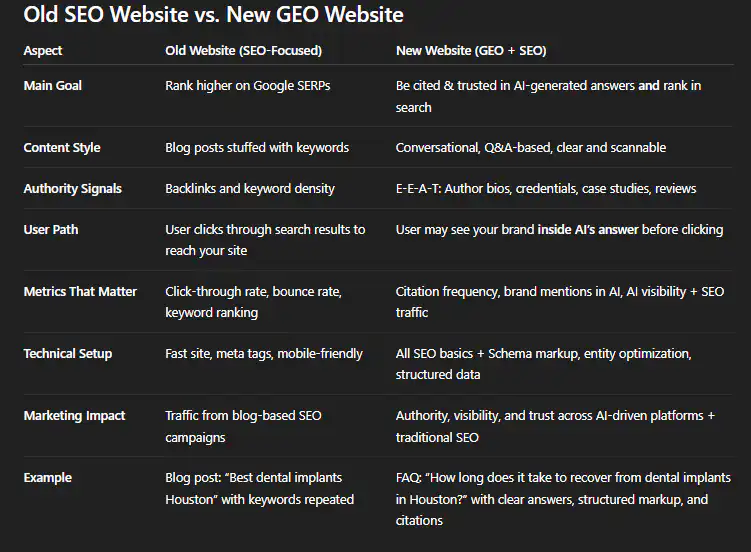
When comparing SEO (Search Engine Optimization) with GEO (Generative Engine Optimization), the difference lies in both their goals and their outcomes. SEO is built around the traditional aim of ranking higher in search results, relying on tactics like keywords, backlinks, and page authority to drive traffic. Its success is measured by metrics such as click-through rates, bounce rates, and overall rankings. GEO, on the other hand, focuses on ensuring content is cited and trusted within AI-generated answers. Instead of keyword-heavy strategies, GEO emphasizes structure, clarity, and strong E-E-A-T signals, including author expertise, credibility, and trustworthiness. The tactics shift as well, with conversational content, FAQs, schema markup, and entity optimization becoming central. While SEO ultimately delivers more traffic from search engines, GEO delivers something equally powerful: authority, visibility, and trust in an AI-first search environment.
How SEO Works
SEO is about helping your site rank well in traditional search results. That means optimizing for:
-
Keywords → What people type into Google
-
Backlinks → Other sites linking to your content
-
Page authority → Reputation and trustworthiness
-
Technical SEO → Fast loading, mobile-friendly, clean code
The reward for good SEO is traffic. More people find your site by clicking through from Google, Bing, or Yahoo.
How GEO Works
GEO, on the other hand, is about helping AI understand and trust your content enough to cite it in generated answers.
Instead of worrying only about keywords, GEO emphasizes:
-
Structured clarity → Using headings, bullet points, and clean formatting
-
E-E-A-T → Demonstrating expertise, experience, and trust (bios, reviews, credentials)
-
Conversational style → Writing in natural, question-and-answer formats
-
Schema markup → Adding structured data so AI can parse your content
-
Entity optimization → Helping AI connect your business to relevant industries, locations, and topics
The reward for good GEO is authority and visibility. Even if users don’t click through, your brand gets cited as the trusted source powering the AI’s answer.
How to Start Implementing GEO
A. Write for Questions, Not Just Keywords
Traditional SEO focused heavily on keywords—the phrases people typed into search engines. While keywords still matter, GEO is about answering real-world questions directly.
Instead of only writing a blog around “dental implants Houston,” for example, frame your content as:
-
“What is the recovery time for dental implants in Houston?”
-
“How much do dental implants cost in Texas?”
-
“Are same-day implants safe?”
This approach aligns your content with how AI models structure their answers. Use FAQs, conversational paragraphs, and examples to ensure your site reads like a direct solution, not just a sales pitch.
B. Show Expertise and Trustworthiness
AI systems like Google’s AI Overviews and ChatGPT favor reliable, credible sources. That means your website must demonstrate E-E-A-T (Experience, Expertise, Authoritativeness, and Trustworthiness). Some quick ways to reinforce this:
-
Add author bios with professional credentials.
-
Display real client testimonials and reviews.
-
Include case studies or success stories to showcase real results.
-
Reference trusted sources and cite them properly.
When AI sees your site as a credible authority, it’s more likely to cite you in generated answers.
C. Use Schema Markup
AI engines and search platforms love structured data. Schema markup is the hidden code that helps them understand your page’s content better. Examples include:
-
FAQ schema for question-and-answer pages.
-
Review schema to show star ratings and testimonials.
-
How-to schema for step-by-step guides.
By applying schema, you make your content machine-readable—and that increases your chance of being pulled directly into AI responses.
D. Keep Content Clear and Scannable
AI works best with content that is easy to parse and summarize. That means avoiding long, cluttered blocks of text and instead creating scannable, structured sections. Tips for scannable content:
-
Use bullet points to break down steps or lists.
-
Add numbered lists for processes or rankings.
-
Keep paragraphs short (2–4 sentences).
-
Use subheadings (H2s and H3s) for clarity.
When your content is clear and structured, AI tools can lift clean snippets from your website, making you the chosen source in an answer.
E. Track AI Visibility
Just as SEO tools help you monitor keyword rankings, new GEO analytics tools are emerging to track how often your content is cited in AI responses. Some platforms now allow you to see:
-
When your brand is mentioned inside AI answers.
-
Which queries triggered AI citations from your site.
-
How your authority is trending compared to competitors.
Tracking this helps you adjust your content strategy and double down on topics where your site is already being cited.
Final Thoughts
SEO isn’t dead—it’s evolving. Generative Engine Optimization (GEO) is not a replacement but an essential upgrade to your digital strategy in 2025 and beyond. If SEO put your website in front of human eyes, GEO ensures your expertise is trusted, cited, and featured in the AI-generated answers that billions of people now rely on. This shift applies to every industry—healthcare, small businesses, e-commerce, construction, and more. Brands that adopt GEO early will gain a decisive advantage in authority and visibility during the AI era. Those that don’t may find themselves invisible, even if they are still “ranking” on traditional search engines. The future of digital visibility isn’t just about being found on page one, it’s about being credible enough to become the answer. At WevTEC, we’re here to help when you see your website traffic dropping, visitors declining, or old SEO strategies falling short. By optimizing your site with E-E-A-T standards and integrating GEO into your strategy, we ensure your business stays visible, trusted, and competitive in the AI-first world.